Rules #
Preparing A Character #
You should prepare your character for a wizard duel. The rules for character creation are as follows.
- Please create your character on this campaign: https://ddb.ac/campaigns/join/14968073048276311. I must have access to your character before the duel can start. If you can’t use the link just make sure I have a copy or send me a link to the read only version.
- Your character’s Race can be one of the following: Dwarf, Elf, Halfling, Human, & Half-Elf.
- Only Wizard for your class.
- You can use any background from the Player’s Handbook.
- Melee isn’t supposed to be the focus. The only weapons you can use are your fists, a quarterstaff, and magic. No bringing longbows into the fray.
- You can use the following feats:
- TODO: critical successes/fails?
Location #
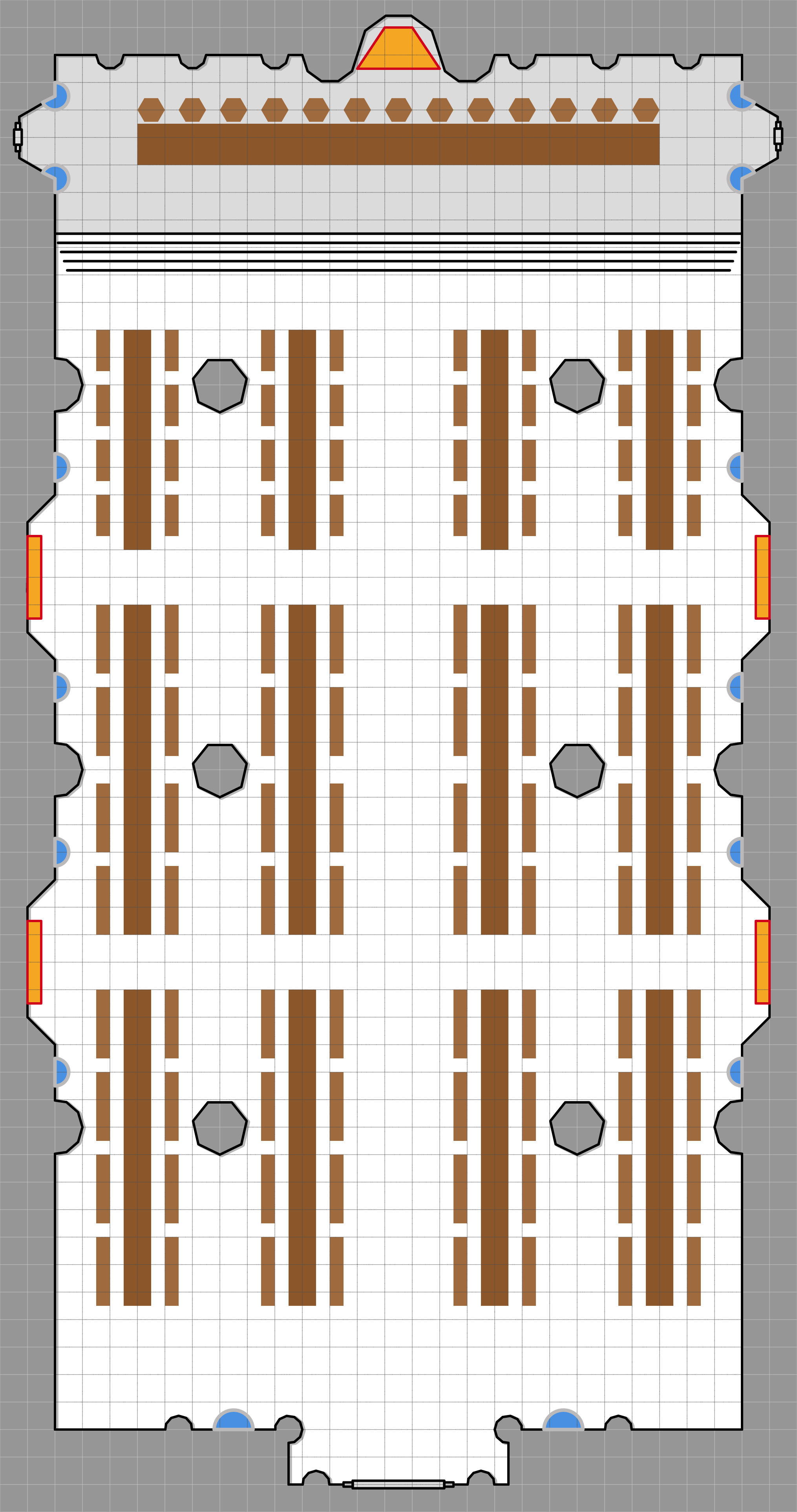
You will battle in the following arena. It might just look familiar (like the great hall in Hogwarts).
- Brown areas are tables and benches/chairs.
- Orange areas are fireplaces.
- Blue circular areas are hand-washing fonts (water).
- Light Grey areas a raised dais.
- Dark Grey areas are the walls.
- Though not shown there are students observing and waiting for their turn to duel to the sides of the central aisle. Though they are standing between the columns they will get out of the way if needed (they won’t obstruct your character’s passage).
- The grid is 5ft. squares.
- We will actually play on this map for the tournament.
Fine Print #
- All players will start with 1 inspiration point at the beginning of each duel. See this for how it can be used.
- The duel will start with an initiative roll as normal.
- You will play on the arena battle map indicated below with the starting positions as marked. The player with the lower initiative will choose their starting location from the areas indicated as starting positions.
- You will declare your turn as usual as detailed here ➡️ 5e Order of Combat:
- Movement or Action
- Attack (Melee or ranged attack)
- Grapple (Special melee attack)
- Shove (Special melee attack)
- Cast a spell (Cast time <= 1 action)
- Dash (Double movement speed)
- Disengage (Prevent opportunity attacks)
- Dodge (Increase defenses)
- Escape (Escape a grapple)
- Help (Grant an ally advantage)
- Use Object (Interact, use special abilities)
- Use shield (Equip or unequip a shield)
- Hide (Search)
- Ready (Choose trigger and action)
- Use class feature (Some features use actions)
- Improvise (Any action not on this list)
- Bonus Action
- Reaction
- Movement or Action
- Critical Success/Fail changes:
- A Critical Success (Rolling 20 on an attack) will cause the maximum damage listed for the attack.
- A Critical Fail (Rolling 1 on an attack) will cause the following:
roll effect 1-3 It’s your lucky day! Stumble 5 feet in a random direction. 4-6 OFF BALANCE- You are flat footed (disadvantage on Dex saves) until the beginning of your next turn. 7 DISTRACTED- Make a Wis save or be -1 to AC and attacks until your next turn. 8 SLIP- Make a Dex check or fall prone. 9-10 WEAPON/ITEM FLIES FROM GRASP- Your opponent uses the disarm spell - do a contested Int check. If your opponent wins the check (their modified result *is greater than* your result) your wand flies from your hand 10ft. in a random direction (d8 - and I'll explain if it comes up) and you must retrieve it before you can cast anything other than a cantrip.If you succeed nothing happens because of the critical fail, but your attack misses.
Clarifications #
Most of this section is just the game rules, but as we are having two players duel I want to make them clear.
On your turn you should wait to roll and announce results until I prompt you. Unlike normal D&D your opponent is another player and may want to do something in reaction to your action. I will prompt for when someone should roll. If you roll before I ask, your opponent may have the advantage of knowing what you rolled before deciding to do something (like spend an inspiration point). You have been warned.
Inspiration #
Your character will start with one inspiration point.
As a reminder inspiration points can be used to do the following:
Gain advantage on an attack roll
- Advantages don’t stack. EG: if you have advantage because your opponent is prone you can’t use inspiration to roll 3 times.
- You can’t call for an advantage after the rolls have started to resolve. EG: You succeed in attacking your opponent, who then uses a reaction to cast shield and raise their AC making your attack fail. In this case if you aren’t sure before you announce your attack roll say “I’m thinking about using inspiration so give me a second, but I rolled a 16.” Otherwise once you announce your roll and I say to your opponent the attack hit - the attacking phase is over and we are into reactions/damage.
- You can use it to nullify a disadvantage. EG: You are prone and cannot stand this turn (disadvantage on attack and ability checks) but decide to attack and roll an 18 - before you roll your second time for disadvantage you can use inspiration to cancel it out and thus keep the rolled 18. If you rolled an 18 followed by a roll of 2 you cannot use inspiration after to cancel the 2. If you roll a 2 initially there isn’t any reason to use inspiration because you will still have the 2.
Gain advantage on a saving throw
- This can mean that if you fail a saving throw against poison you can use an inspiration point to roll a second time and hope to succeed on your saving throw in the second roll (it doesn’t guarantee a success, just another try). You need to indicate that you are going to use inspiration before you finish announcing your first roll. This should be an easy decision, because before you roll for the saving throw you should know what you have to beat. If you don’t remember and need to check ask before you announce your roll!. EG: your opponent casts 🔎 Frostbite ➡️ you or I should immediately ask what your opponent’s spell save DC is. They announce it is a Constitution saving throw and their spell save DC is 13. After that roll. If you get a 10 + 1 (Your constitution mondifier is +1) you know you have failed the saving throw and should say “I’m using an inspiration point because I rolled a 10.”.
Attackers take note: you should not roll or announce your damage until I say to do so. If your opponent rolls a 10 and you immediately roll damage and say “Yes 8 points of damage!!!” before they announce what they rolled then they can still declare they are using an inspiration point. Additionally if you announce that you rolled a 1 for damage before they announce their saving throw roll they may decide not to use an inspiration point.
Gain advantage on an ability check.
- You indicate that your character is going to jump over the chasm and roll a 3 + (3 Athletics) for a 6. I indicate that you wouldn’t make it and are going to take bludgeoning damage. Before I roll for damage announce “I am going to use an inspiration point” and you will get a second roll. Once I have completed rolling for damage and start announcing the amount you can’t then use an inspiration point.
- Use it to offset a disadvantage. EG: you say that your character leaps over the chasm, and I indicate that you have disadvantage because of difficult terrain and would need to roll for Athletics, Acrobatics, Dexterity or Strength. You can roll your first roll - and seeing that you got a 16 say “I am going to use an inspiration point.” At which point you won’t have to roll the second time for disadvantage. You could also say “Hey how difficult is this jump going to be?” To which I might reply trivial (don’t roll a 1), easy (beat about a 5), moderate or tough (beat about a 10), hard (beat about a 15), heroic (beat about a 20), almost impossible (beat about a 25), impossible (beat about a 30). That way you can get a better idea of if you really need to use your inspiration point to offset the disadvantage.
You Cannot do the following:
- You cannot use it to re-roll damage. EG: you rolled 1, 2, & 1 on a 3d8 for damage - you can’t use inspiration to re-roll one or all of the damage dice.
- You cannot use it to cause disadvantage for your opponent. EG: you use the spell 🔎 Poison spray ➡️ which means that your opponent needs to make a constitution saving throw. You can’t use an inspiration point to attack, because it isn’t an attack roll, nor can you use your inspiration to cause disadvantage on your opponent.
- You cannot nullify your opponent’s advantage. EG: You were knocked prone because of a critical fail from your attack the prior turn, and you had already moved so you couldn’t get up. Your opponent decides to attack with their quarterstaff as they are next to you - and thus would have advantage (prone actually gives your attacker disadvantage on ranged attacks). You cannot use an inspiration point to nullify their attack advantage.